
A common misconception among crypto traders is that opening an account on a major exchange is a frictionless, featureless step—click, verify, trade. In practice the verification path, login choices, and product permissions you accept determine what strategies are practicable, how much counterparty risk you bear, and which markets you can access. For US-based traders considering OKX, these operational details matter: margin and derivatives access, the safety of custody, and even the ability to trade specific tokens all hinge on how you complete identity verification (KYC) and secure your login.
This article lays out the mechanisms that matter during account creation and login on OKX, compares alternatives, surfaces trade-offs and limits, and ends with concrete heuristics you can apply before you deposit capital. The aim is not to advertise OKX but to explain what its design choices imply for a US trader who wants to use spot, margin, or derivatives products while managing regulatory and security trade-offs.
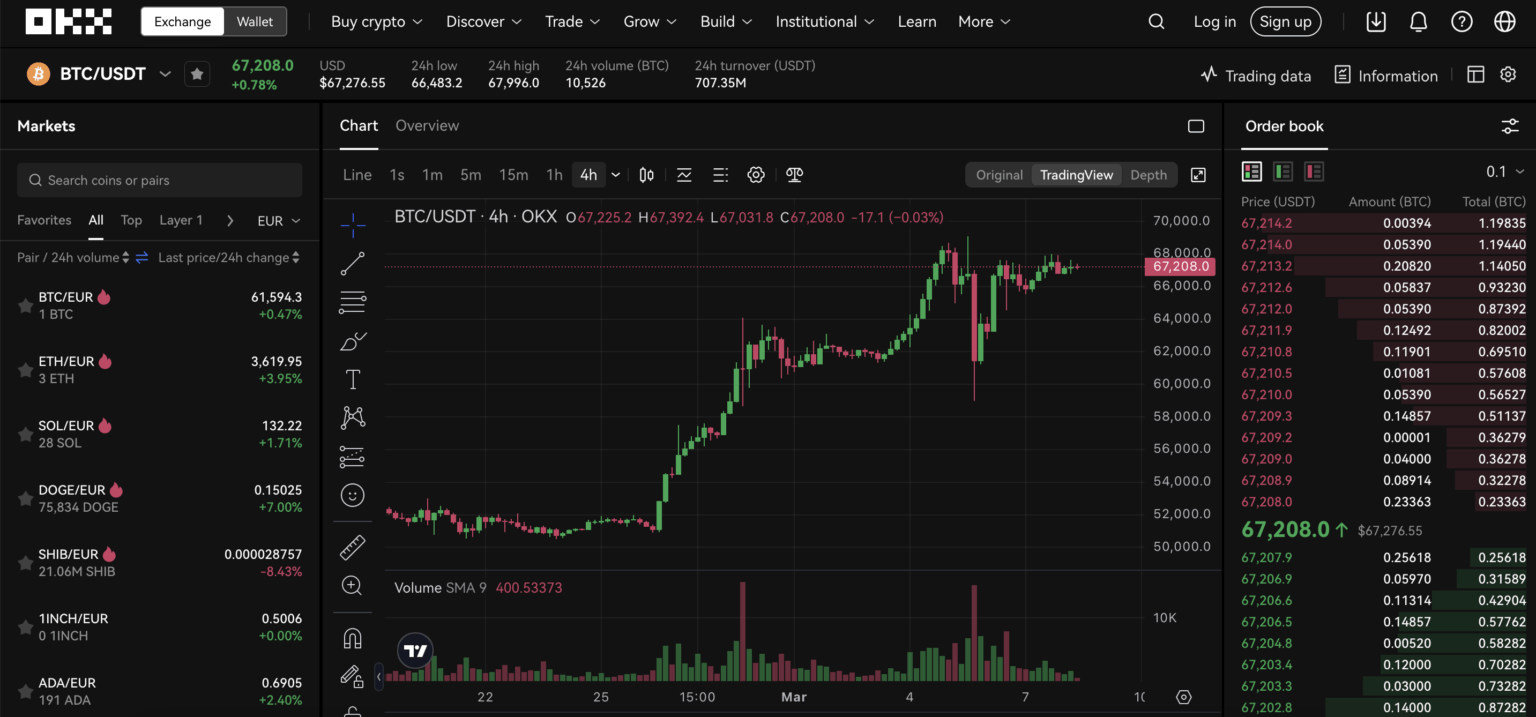
How OKX verification and account setup actually work (mechanisms, not slogans)
OKX follows a standard KYC flow driven by AML compliance: you provide a government-issued ID and complete a facial liveness check. This verification unlocks higher withdrawal limits, fiat rails, and eligibility for margin and derivatives. Mechanically, the exchange links your account credentials to an identity record; that record is used for regulatory reporting and to gate product access. That creates two immediate consequences: first, you cannot anonymously use the platform for anything more than minimal, likely restricted operations; second, your ability to use high-leverage products is contingent on passing KYC and meeting any jurisdiction-based restrictions.
Login and account protection incorporate multiple layers: military-grade encryption at rest, AI-driven anomalies detection for suspicious logins, and mandatory two-factor authentication (2FA) using SMS, Google Authenticator, or biometrics (on mobile). The platform also supports biometric logins on iOS and Android, and a browser extension that slots into Web3 workflows. Practically, that means you have choices: custodial convenience (CEX account with 2FA) versus self-custody with the OKX non-custodial wallet. The former simplifies derivatives use; the latter reduces third-party custody risk but increases responsibility for seed phrase security.
Where the trade-offs matter: product access, custody, and risk
Choose custody, and you trade counterparty risk for usability. OKX stores over 95% of user assets in air-gapped cold wallets using multi-signature withdrawal controls—this materially reduces large-scale hacking risk compared with naive custodial models. It also publishes Proof of Reserves (PoR) on-chain to show backing of deposits. Yet PoR and cold storage do not remove all risk: operational bugs, exchange insolvency, or forced freezes under legal process remain non-technical hazards. If you prioritize absolute control, the OKX Web3 wallet lets you self-custody and connect hardware wallets like Ledger and Trezor; that path prevents exchange bankruptcy from touching funds you never deposited, but it precludes trading on OKX’s centralized order books unless you move assets back on-chain and re-deposit.
Product permissions are another trade-off. Spot and margin trading are available after KYC, and margin offers up to 10x leverage in isolated or cross-margin modes. Advanced traders can access futures and options—up to 125x on certain perpetuals—only where permitted. High leverage amplifies returns but also amplifies liquidation and funding costs, especially during high volatility or when liquidity is thin. Traders accustomed to retail platforms often underestimate the speed of margin drains during rapid moves; even with a platform that has deep liquidity on major pairs, niche token pairs or recently delisted pairs (OKX recently delisted several low-volume spot pairs this week) can exhibit wide spreads and slippage that make leveraged strategies hazardous.
Comparison with two alternative approaches
Consider two common alternatives: using a US-regulated fiat-on-ramp focused exchange (Option A) or pursuing direct DeFi trading with self-custody (Option B). Option A typically provides straightforward fiat deposits/withdrawals, often stricter KYC, and explicit regulatory compliance—good for traders who want strong fiat interoperability and legal clarity. The trade-off is that stricter local regulation can limit access to some derivatives or certain tokens. Option B (self-custody + DEXs) maximizes censorship-resistance and control, but it exposes you to smart contract risk, composability complexity, and generally less sophisticated order types (no centralized limit order book, margin, or guaranteed execution). OKX sits between these: it is a CEX with an integrated Web3 wallet and DEX aggregator, offering a hybrid set of features. For many US traders, that hybrid is pragmatic: you get order-book trading plus an easy portal into DeFi swaps and staking, but you must accept KYC and the centralized custody model if you deposit to trade.
Operational checklist before you hit “okx login”
Before you attempt to log in and complete KYC, run this short checklist: (1) Decide custody model—will you keep assets off-exchange or deposit? (2) Choose 2FA method and set up an Authenticator app; avoid SMS as the sole factor where possible. (3) Prepare government ID and a quiet environment for the liveness check to reduce verification retries. (4) If you plan to trade derivatives, confirm your state’s permitted access and whether additional verification tiers are required. (5) Map which assets you need; OKX supports 300+ tokens and 130+ chains, but not all tokens are available on every product. This last point ties to the recent delisting of several low-volume spot pairs: routine delistings aim to protect liquidity and market quality, but they also mean a token you wanted might no longer be available for spot trading on the exchange.
For a smooth entry to the web interface, use the official login path and bookmark it; one natural entry point for users is the platform’s web login page. If you want the direct web route, see the official okx login guidance linked below for orientation and step-by-step prompts.
Limits and boundary conditions every US trader should accept
Three boundary conditions are often glossed over. First, regulatory exposure: US-based users may face restrictions on specific derivatives or token listings depending on state and federal guidance. OKX’s product set is broad, but not uniformly available. Second, liquidity and slippage: even on major exchanges, liquidity is pair-specific and can evaporate during spikes; high leverage increases sensitivity to this. Third, identity permanence: once you complete KYC, your identity is linked to your trades and balances; reversing that linkage is generally impractical. These are not bugs—they are structural constraints from AML regulation and market microstructure—but they should affect how you allocate positions, size leverage, and plan for withdrawals under stress.
Practical heuristics and a simple mental model
Here are three heuristics you can reuse: (1) “Custody-first decision”: if you plan to use leverage or centralized order books frequently, deposit only the operational capital you need and leave the rest in a hardware wallet or self-custodial account. (2) “KYC as an access gate”: treat KYC as a permissions switch—do it if the benefits (fiat rails, higher limits, derivatives) outweigh the privacy costs. (3) “Liquidity lens”: test execution on small trades first, especially for low-cap tokens; measure slippage and order book depth before scaling. These rules reduce surprise and map directly to the platform’s design choices.
What to watch next (signals, not predictions)
Watch for three classes of signals. First, product delistings and relistings—routine pruning of low-volume pairs (as seen this week) signals tighter quality controls and can affect access to niche tokens. Second, regulatory actions or guidance in the US that could constrict derivatives availability—such a change would alter the risk/reward calculus for leveraged strategies. Third, technical integrations: deeper hardware wallet support or expanded Layer 2 bridges will shift the custody-versus-convenience trade-off incrementally toward hybrid flows. These are conditional scenarios; each will matter only if accompanied by concrete policy or engineering changes.
FAQ
Q: How long does OKX KYC take for US users?
A: It varies with volume and verification quality. If your ID photo and liveness check are clean and the system has no backlog, expect a short turnaround (minutes to hours). Complications—blurred images, mismatched documents, or manual review triggers—can extend that to days. Plan accordingly if you need margin or fiat rails promptly.
Q: Can I use OKX derivatives in every US state?
A: Not necessarily. Availability of derivatives and high-leverage products depends on regulatory permissions that differ by jurisdiction. You should confirm product availability after KYC and before placing leveraged trades. The platform will typically block access to restricted products rather than allow you to trade them.
Q: Is the OKX Web3 wallet safer than keeping funds on the exchange?
A: “Safer” depends on the risk you prioritize. A self-custodial wallet reduces counterparty and custodial insolvency risk; it introduces persistent responsibility for seed phrase security and smart contract risks if you use DeFi. Cold storage on the exchange mitigates online hack risk for most assets but keeps funds within the exchange’s operational perimeter—use the wallet for long-term control and the exchange for active trading capital, sized thoughtfully.
